
Successful office acoustic design Philippines involves managing sound in BPOs and government offices through a combination of absorption, blocking, and masking solutions. This strategy utilizes acoustic panels and specialized work zones to follow ISO 22955 standards, ensuring high productivity and comfort in busy open-plan environments.
In the high-density environments of Philippine BPOs and government institutions, the constant hum of conversation and equipment often transcends mere distraction. It becomes a critical barrier to productivity and data privacy. At RA Integrated Solutions, we recognize that an uncontrolled acoustic environment directly impacts employee focus and operational efficiency. Achieving a balanced workspace requires more than just high partitions; it demands a technical understanding of how sound behaves within a professional setting. This guide explores the essential metrics of acoustic performance, including NRC and STC ratings, while introducing the strategic framework of absorbing, blocking, and covering sound. From specialized furniture selections to comprehensive acoustic audits, you will learn how to transform a chaotic floor plan into a refined, high-performance workspace tailored for the unique demands of the Philippine market.
The High Cost of Noise in Philippine Workplaces
Business districts in the Philippines, from the vertical density of Makati and BGC to the expanding hubs in Cebu and Clark, present a unique set of acoustic challenges. Space is a premium, often resulting in high-density floor plans where workstations are packed tightly. This concentration of activity, combined with the bustling urban environment outside, creates a persistent wall of sound. Research indicates that open-plan offices in the Philippines frequently reach ambient noise levels of 55 to 70 dB during peak hours. This significantly exceeds the World Health Organization’s recommendation of 55 dB for cognitive tasks, transforming the workplace into a source of mental fatigue rather than a site for productivity.
For the Business Process Outsourcing (BPO) sector, noise is a direct threat to service quality. Agents require clear communication to resolve complex issues; however, background chatter and distractions can lead to errors and decreased customer satisfaction. In the public sector, the stakes are equally high. Government offices handling sensitive data or public grievances must maintain confidentiality. Without professional office fit-out services, private conversations can easily carry across corridors, compromising legal requirements for privacy and data security.
Approaching office acoustic design Philippines is no longer an aesthetic luxury; it is a critical business infrastructure investment. When sound is mismanaged, productivity drops and employee burnout increases. Strategically implementing solutions such as operable partition walls or high-density mobile compactor units serves a dual purpose: maximizing the utility of a floor plan while creating the acoustic barriers necessary for a high-functioning environment.
Decoding Acoustic Performance: Understanding NRC and STC Ratings
Selecting the right materials for office acoustic design Philippines requires a clear understanding of two primary metrics: NRC and STC. These ratings define how a product handles sound energy and determine its suitability for specific zones within a workspace.
NRC (Noise Reduction Coefficient) measures sound absorption. Represented on a scale from 0 to 1, it indicates the percentage of sound a surface soaks up. For example, a PET felt panel with an NRC of 0.85 absorbs 85 percent of the sound that hits it, effectively reducing echo and reverberation. This is essential in open plan areas where hard surfaces like polished concrete or ceramic tiles, common in Philippine commercial buildings, would otherwise cause noise to bounce and linger.
STC (Sound Transmission Class) measures sound blocking. Unlike NRC, which deals with sound within a room, STC quantifies how much sound is prevented from passing through a barrier to the other side. A standard drywall partition might offer an STC of 30 to 35, which allows loud speech to be heard clearly. In contrast, professional operable partition walls are engineered for higher STC ratings, ensuring that confidential discussions in a boardroom remain private from the adjacent hallway. Understanding these technical distinctions ensures that procurement decisions lead to measurable improvements in speech privacy and concentration.
The ABCs of Acoustic Design: Absorb, Block, and Cover
Practical application of acoustic principles relies on the industry-standard ABC framework: Absorb, Block, and Cover. Implementing this strategy requires a nuanced understanding of the Philippine built environment, where maintenance requirements often dictate the use of hard-surfaced materials. While ceramic tiles and polished concrete are preferred for their durability in humid climates, they are highly reflective surfaces that exacerbate noise issues. A layered approach is necessary to counteract these architectural challenges.
Strategy | Mechanism | Common Solutions |
|---|---|---|
Absorb | Reduces echo by soaking up sound energy. | PET felt panels, acoustic ceiling tiles, fabric baffles. |
Block | Stops sound from traveling between zones. | operable partition walls, high-density workstations. |
Cover | Masks distracting sounds with white noise. | Electronic sound masking systems, ambient background audio. |
Absorption is the first line of defense against the reverberation typical in high-density Manila offices. High-density PET (polyethylene terephthalate) panels are particularly effective because they can be mounted on walls or suspended as baffles to intercept sound before it hits hard surfaces. For the blocking component, the goal is to create a physical break in the sound's path. This is achieved through office fit-out services that prioritize high-STC barriers, such as workstations with integrated acoustic dividers. These dividers provide immediate speech privacy for employees without requiring full-height permanent walls.
The final layer, covering, involves sound masking systems that emit a gentle, engineered background noise. This reduces the signal-to-noise ratio of distant conversations, making them less intelligible and therefore less distracting. In the Philippines, layering these strategies is more effective than relying on a single product. For instance, combining PET desk dividers for absorption with mobile compactor units for blocking creates a multifaceted acoustic barrier that addresses both high-frequency chatter and low-frequency mechanical noise.
Acoustic Strategies for Philippine BPOs and Call Centers

The unique operational density of Philippine BPOs necessitates a specialized application of the ABC framework. In these environments, the most persistent distraction is the halfalogue, the phenomenon of hearing only one side of a verbal exchange. Cognitive research suggests that halfalogues are significantly more distracting than full conversations because the human brain actively tries to predict the missing parts of the dialogue; this process pulls focus away from complex tasks and leads to rapid mental fatigue.
To address this, workstation layouts must go beyond basic desking. Implementing high-walled acoustic cubicles paired with PET desk dividers provides a critical localized barrier. These dividers should ideally reach a height of at least 500mm above the work surface to intercept the direct line of speech between agents. This configuration not only reduces the ambient hum of the production floor but also enhances speech privacy. For international BPO clients, ensuring that sensitive customer data mentioned during a call is not overheard is a vital security and compliance requirement. In this context, office acoustic design Philippines acts as a layer of data protection.
Beyond the main production floor, office fit-out services should include designated quiet zones for supervisors and agents. Acoustic pods or modular phone booths offer an STC-rated sanctuary for deep work, confidential coaching sessions, or private calls. These self-contained units prevent sound leakage in both directions, ensuring that sensitive discussions remain private while protecting the occupant from the surrounding noise. Integrating these specialized furniture solutions into the floor plan creates a structured environment where high-volume communication and high-concentration tasks can coexist without friction.
Managing Privacy in Government and Institutional Offices

Government and institutional offices in the Philippines operate under mandates that prioritize both transparency and strict confidentiality. Departments managing sensitive records, legal proceedings, or public grievances require acoustic environments that guarantee speech privacy to protect citizens' data and comply with legal requirements. Unlike the open production floors typical in the BPO sector, government agencies often utilize large, multi-purpose halls that must shift from public forums to private consultation spaces quickly.
Implementing operable partition walls allows facilities managers to transform a noisy auditorium into several sound-secure meeting rooms in minutes. These systems provide the high Sound Transmission Class (STC) ratings necessary to prevent information leaks, a vital feature for offices handling sensitive documents. All acoustic interventions in these sectors must align with the National Building Code of the Philippines, which sets specific parameters for noise control and environmental comfort in institutional buildings.
Effective office acoustic design Philippines for the public sector also involves leveraging furniture as a structural sound barrier. For example, placing high-density mobile compactor units along shared walls acts as a secondary mass barrier, shielding administrative offices from the echoes of public lobbies. Through professional office fit-out services, government entities can secure infrastructure that meets these technical standards while maintaining the flexibility needed for high-traffic institutional environments.
The Role of Furniture in Acoustic Management
Every piece of furniture in a workspace serves as an acoustic tool, either contributing to sound absorption or acting as a physical barrier. In high-density Philippine offices, where hard flooring often creates significant reverberation, furniture selection is a tactical decision for sound control. Fabric task chairs, for instance, do more than provide ergonomic support; their porous materials help dampen mid-frequency sounds that would otherwise reflect off tiled or polished concrete surfaces. Similarly, high-density mobile compactor units serve a dual purpose. Beyond their primary storage function, these heavy, solid units act as substantial mass barriers that intercept and block sound transmission across large, open floor plates.
RA Integrated Solutions provides furniture systems where acoustic management is a primary engineering requirement rather than an afterthought. Our integrated workstations include built-in PET felt dividers and fabric-wrapped panels that provide immediate NRC benefits right at the source of speech. By linking furniture procurement directly to acoustic outcomes through professional office fit-out services, facilities managers can optimize a room’s sound profile effectively. These furniture choices work in tandem with operable partition walls to create a cohesive, low-decibel environment without requiring intrusive structural renovations.
How to Conduct an Office Acoustic Audit
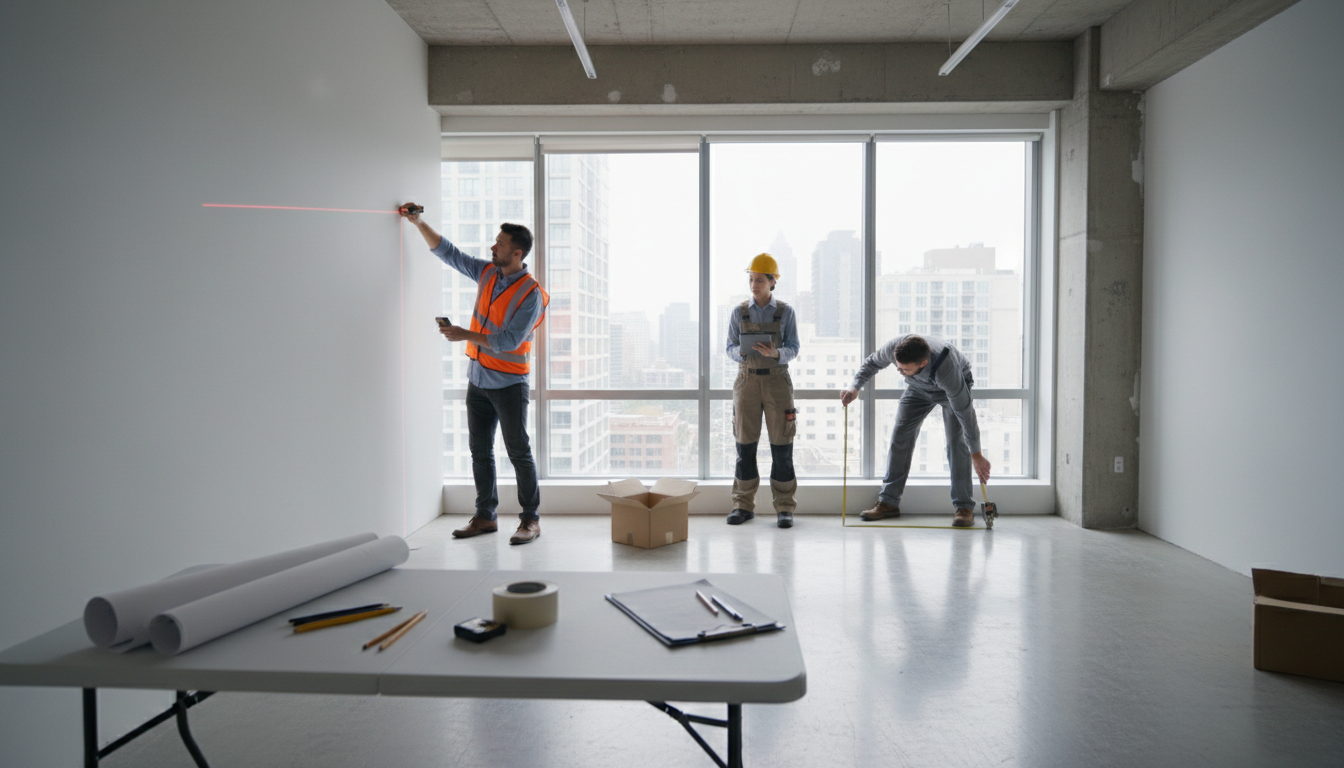
Facilities managers can begin an audit by mapping ambient noise levels during peak shift hours, typically mid-morning or mid-afternoon. If readings consistently exceed 60 dB, the environment is likely impairing cognitive function. Next, identify sound leaks or flanking paths; these are often found in gaps under doors, unsealed joints in operable partition walls, or shared ceiling plenums.
Follow this with a surface inspection to locate acoustic mirrors. These are hard surfaces, such as glass-walled boardrooms and polished stone floors, that reflect sound rather than dissipate it.
Measure: Record decibel levels at workstations and meeting rooms during peak activity using a calibrated sound level meter.
Inspect: Check for physical gaps in partitions, perimeter door seals, and electrical outlets.
Evaluate: Note the proximity of high-traffic zones, like pantry areas or mobile compactor units, to quiet focus desks.
If high-decibel readings persist despite minor adjustments, consult a professional partner for office fit-out services. Expert measurement of reverberation times ensures that your office acoustic design Philippines strategy is data-driven. Addressing these issues is consistently more cost-effective than absorbing the long-term expense of employee burnout and the productivity losses caused by excessive noise.
Creating a productive workspace in the Philippines requires balancing open communication with acoustic privacy. Whether you are managing a high energy BPO or a focused government office, the right layout and materials make all the difference. If you want expert help in designing a quiet environment, choosing the right Office Furniture is a critical first step. Our team at RA Integrated Solutions is ready to help you navigate these choices to ensure your office remains both functional and peaceful for your entire staff.