Successful procurement of stadium and theater seating in the Philippines depends on selecting UV-stabilized, fire-retardant materials like HDPE to withstand tropical weather and heavy use. This stadium theater seating Philippines procurement guide recommends adhering to international durability standards such as EN 12727; it also focuses on impact-resistant designs and powder-coated frameworks to ensure long-term performance in local venues.
Procuring stadium or theater seating in the Philippines often involves a complex balance between strict budgetary constraints and the harsh realities of a tropical environment. Many facility managers and government agencies struggle with seating that fades under intense UV exposure or fails prematurely due to high humidity and salt air. This instability leads to costly replacements and potential safety liabilities that jeopardize the long-term viability of the venue. At RA Integrated Solutions, we understand that professional grade seating must meet rigorous international standards while adhering to local procurement protocols. This guide provides a comprehensive framework for navigating the technical specifications required for both indoor and outdoor applications. You will learn how to evaluate material durability, optimize sightlines for spectator comfort, and successfully manage the Bids and Awards Committee process to ensure your investment delivers lasting value.
Understanding the Complexity of Philippine Seating Procurement
Navigating large-scale seating projects in the Philippines requires a sophisticated understanding of both environmental resilience and strict regulatory frameworks. Unlike temperate regions, the Philippine climate presents a uniquely hostile environment for architectural products. High humidity levels accelerate oxidation in metal supports, while intense tropical UV radiation can cause rapid color fading and structural brittleness in substandard polymers. Without precise stadium seating specifications, an outdoor venue can see significant material failure in as little as twenty-four months.
For public sector projects, the Bids and Awards Committee (BAC) must operate within the established mandates of RA 9184, the Government Procurement Reform Act, while preparing for the procedural transitions introduced by RA 12009, the New Government Procurement Act. These laws are designed to ensure transparency; however, they often create a tension between immediate budget constraints and the long-term integrity of the installation. This stadium theater seating Philippines procurement guide helps stakeholders bridge that gap by defining "Value for Money" through technical merit rather than just the lowest initial price.
Effective government procurement services and private development strategies must prioritize materials that withstand the local elements. Balancing these requirements ensures that theater seating solutions meet acoustic and safety standards while providing a life cycle that justifies the institutional investment.
Technical Specifications for Outdoor Stadium Seating in Tropical Climates
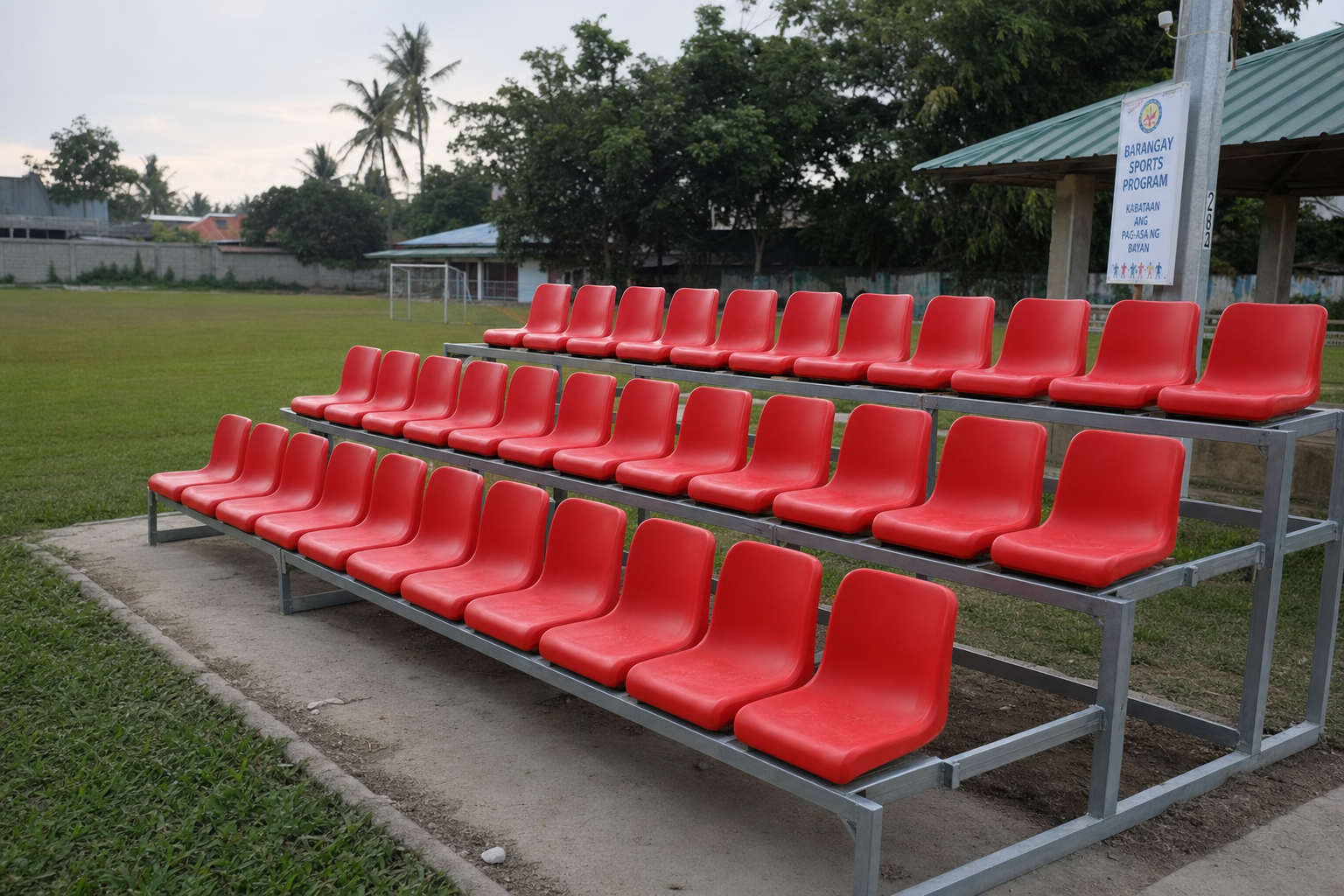
Outdoor seating in the Philippines faces a relentless assault from solar radiation and moisture. When establishing stadium seating specifications, the primary defense against structural degradation is the use of UV-stabilized polypropylene or High-Density Polyethylene (HDPE). These polymers must be chemically treated in-mass, meaning the UV stabilizers and high-quality pigments are integrated throughout the material during the mixing process rather than applied as a surface film. This is essential for meeting international standards like UNE-EN 13200-4, which requires rigorous accelerated aging tests of up to 2,300 hours to ensure the seats do not become brittle or lose impact resistance under the intense tropical sun.
The choice between manufacturing methods also dictates long-term performance in provincial sports complexes. Injection-molded seats offer high precision and solid structural integrity, whereas blow-molded seats provide a double-walled, hollow construction that excels in impact absorption. For high-traffic public venues, blow-molding often provides superior resilience against mechanical stress. Regardless of the molding technique, the design must include engineered drainage holes. During the Philippine typhoon season, standing water causes mold growth and accelerates polymer breakdown; a well-placed drainage aperture is a simple but critical requirement for maintaining hygiene and material longevity.
Metal supports require equal scrutiny to prevent the rapid oxidation common in high-humidity coastal or urban environments. For steel frameworks, hot-dip galvanization is the industry benchmark. This process creates a metallurgical bond that protects the steel even if the surface is scratched. Alternatively, powder-coated aluminum offers excellent corrosion resistance and better thermal properties, as it does not retain heat as aggressively as steel. Specifying these anti-corrosive measures ensures that the stadium theater seating Philippines procurement guide remains a roadmap for quality, preventing the premature structural failures that often plague low-cost, unprotected installations.
Indoor Theater and Auditorium Seating: Acoustics and Safety Standards
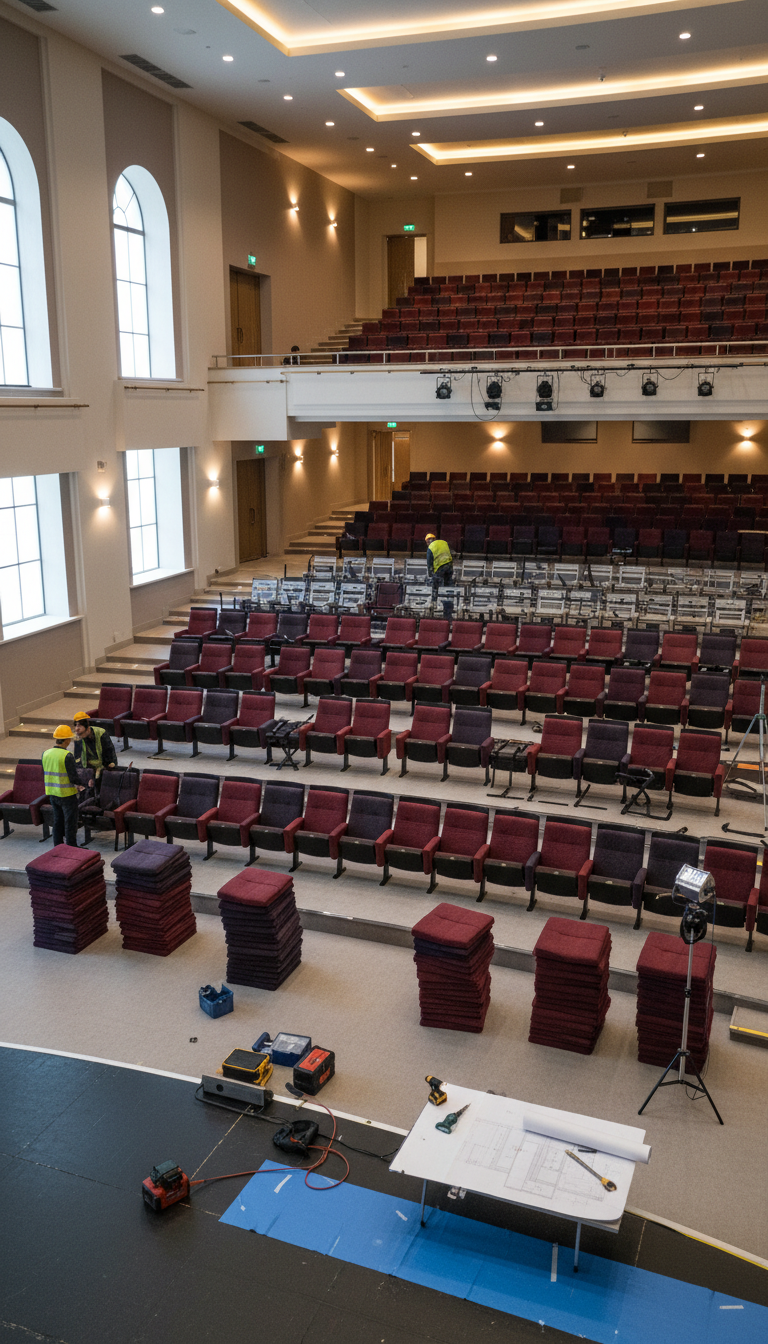
While outdoor venues prioritize weather resistance, indoor facilities such as university theaters and government convention centers demand a focus on human safety and sensory performance. Indoor theater seating solutions must navigate the stringent requirements of the Fire Code of the Philippines, also known as RA 9514. It is critical for the stadium theater seating Philippines procurement guide to specify materials that comply with international fire retardancy standards such as ASTM E84 or BS 5852. These certifications ensure that foams and upholstery fabrics are treated to self-extinguish or resist ignition, providing vital minutes for safe egress during an emergency.
Acoustic performance is the secondary pillar for indoor venues. The chair functions as a sound-absorbing tool; an empty auditorium should ideally possess the same acoustic signature as one filled with people. This balance is maintained by selecting chairs with perforated under-seat pans and specialized acoustic foam densities. If the seating is too reflective, it creates echoes that degrade speech intelligibility in lecture halls and musical clarity in theaters. Professionals should look for stadium seating specifications that detail the Noise Reduction Coefficient (NRC) of the chosen materials to ensure the venue’s sound quality remains consistent regardless of attendance levels.
For long-term institutional value, government procurement services should emphasize fabric durability and ergonomic integrity. Upholstery should be rated using the Wyzenbeek or Martindale tests; a minimum of 50,000 double rubs is the standard for high-traffic environments to prevent fraying and thinning. Furthermore, specifying high-density, cold-molded polyurethane foam ensures the seat maintains its shape and lumbar support over decades of use. This differs significantly from cheaper cut-foam alternatives that sag and lose comfort after only a few years of heavy use in a university or government setting.
Navigating the BAC Process: Procurement Modes and Bidding Documents
Navigating the BAC process successfully requires a deep dive into the stadium theater seating Philippines procurement guide principles of technical compliance and procedural transparency. Bids and Awards Committees (BAC) must utilize the standard Philippine Bidding Documents (PBDs) for Goods, specifically the latest editions aligned with the Government Procurement Policy Board (GPPB) guidelines. While Public Bidding remains the default for major venue installations, Small Value Procurement (SVP) under Section 53.9 of the IRR of RA 9184 is frequently utilized for specialized maintenance or smaller theater seating solutions.
A frequent pitfall in public procurement is drafting technical specifications that are too broad. Under the principle of non-brand-specific procurement, the law prohibits naming a preferred manufacturer. However, the BAC and its Technical Working Group (TWG) should specify high-performance standards that filter out inferior products. Instead of requesting generic plastic seats, the documents should define the polymer's material properties and specific testing certifications. This ensures the agency receives Value for Money as highlighted in RA 12009, prioritizing lifecycle quality over the lowest initial price tag.
Technical Criteria | Generic/Weak Specification | Stringent Performance Specification |
|---|---|---|
Material Composition | Polypropylene shell | UV-stabilized HDPE (UV8 rating) with mass-integrated pigment |
Structural Support | Metal frame with paint | Hot-dip galvanized steel or Powder-coated Aluminum |
Durability Rating | Durable for outdoor use | Static load resistance of 2,000N per EN 12727 Level 4 |
Fire Safety | Fire resistant | Compliance with RA 9514 and ASTM E84 Class A standards |
By embedding these stadium seating specifications into the technical requirements, the TWG establishes an objective benchmark for evaluation. This technical rigor allows government procurement services to disqualify bidders whose samples fail to meet chemical density or fire retardancy requirements, protecting the institution from the long-term costs of brittle, fading, or unsafe seating.
Design Considerations: Capacity, Sightlines, and Egress
Transitioning from procurement paperwork to physical implementation requires a shift toward architectural integration. Designing effective seating plans requires balancing maximum seating capacity with the strict life safety requirements of the National Building Code of the Philippines (PD 1096). For indoor auditoriums and theaters, the Code dictates specific aisle widths and maximum travel distances to exits. For instance, the minimum clear width of an aisle is typically 1,100 millimeters for aisles serving both sides. Calculating capacity involves more than just floor area; it must account for the clear width between rows when seats are in use to ensure that occupants can move freely during an emergency egress.
To optimize the viewing experience, theater seating solutions must incorporate staggered seating arrangements. By offsetting chairs in alternating rows, sightlines are maintained even in venues with minimal floor raking; this prevents a patron's view from being blocked by the person directly in front of them. When drafting stadium seating specifications, planners should also consider C-value calculations, which measure the vertical distance from a spectator's eyes to the top of the head of the person in the row below. Integrating these design principles into the stadium theater seating Philippines procurement guide ensures the final installation is not only high-capacity but also functionally superior and fully compliant with local safety mandates.
Total Cost of Ownership: Why Cheap Seating Costs More
Selecting seating based on the lowest initial bid often leads to a cycle of expensive replacements and operational downtime. In the Philippine market, a high-quality theater chair priced at PHP 8,000 with a 15-year lifespan represents far greater value than a PHP 4,000 alternative that suffers mechanical failure or fabric tearing within three years. Over a fifteen-year horizon, the budget option requires five full replacement cycles, resulting in a total expenditure of PHP 20,000 per seat, excluding the recurring costs of labor, logistics, and disposal.
This financial disparity is particularly pronounced in multi-purpose gyms utilizing telescopic seating systems. Unlike fixed installations, telescopic units involve complex motorized components and tracking systems that demand precision engineering. Inferior systems frequently seize or misalign due to the high humidity levels typical in local climates; this leads to recurring repair bills that quickly surpass any initial savings. When agencies utilize government procurement services, evaluating the Total Cost of Ownership (TCO) becomes a fiduciary necessity. By prioritizing stadium seating specifications that mandate UV-stabilized polymers and corrosion-resistant metalwork, institutions secure theater seating solutions that remain functional for decades. This stadium theater seating Philippines procurement guide emphasizes that the real cost of a chair is measured by its performance across its entire lifecycle, not its price at the warehouse door.
Navigating technical specifications for large scale venues requires a balance between safety standards and long term durability. Choosing the right materials ensures that your facility remains functional and comfortable for years to come. If you prefer expert guidance to manage these complex procurement details, our team can assist you in finding the perfect fit. When planning your next project, exploring specialized Theater Seating options with RA Integrated Solutions A Brand of Rootstone Approach Furniture Trading can help you achieve a seamless and compliant installation.