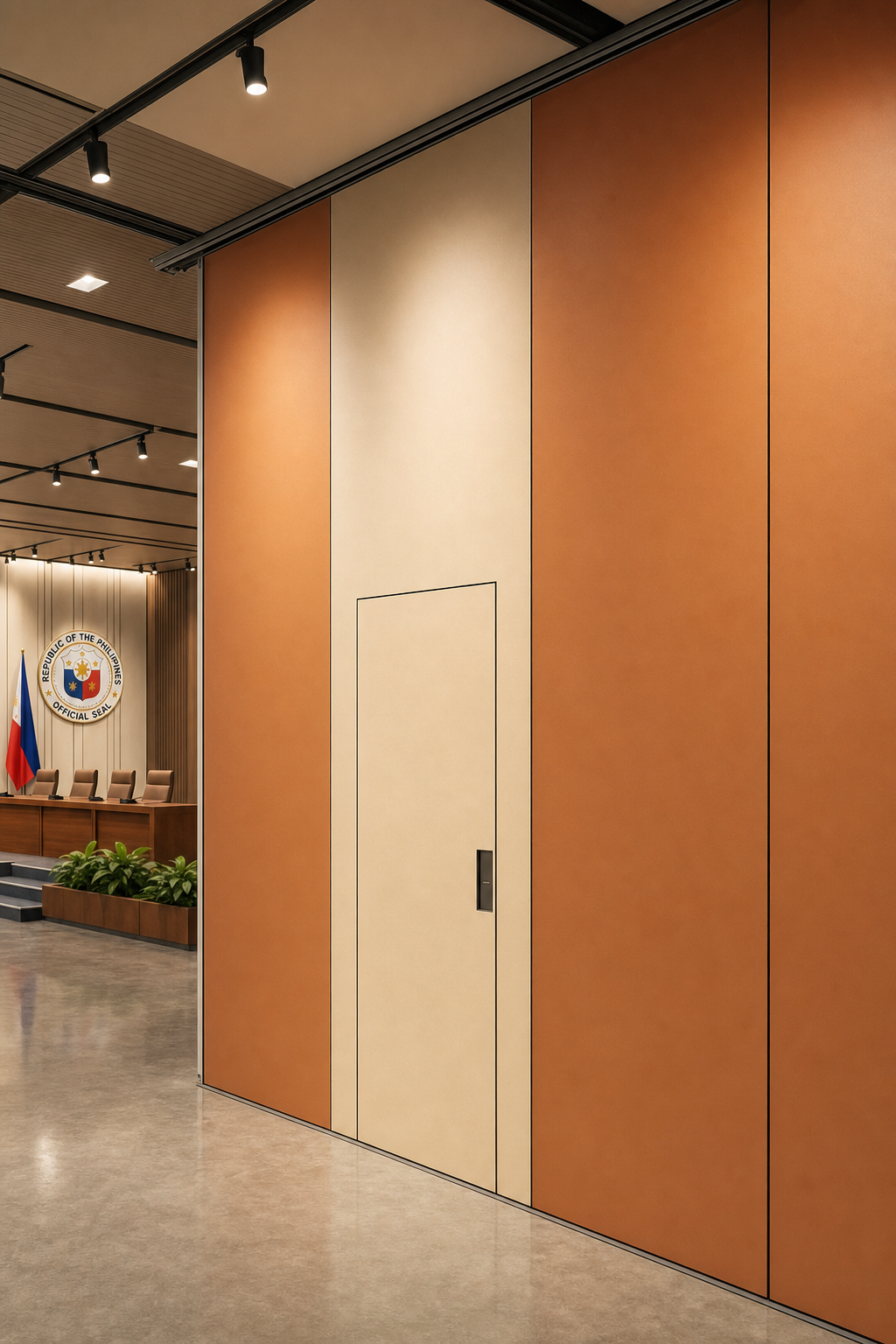
Higher ratings for operable partition wall acoustics STC Philippines indicate a system's ability to block more decibels, ensuring acoustic privacy in divided commercial spaces. These ratings are essential for businesses that require flexible layouts while maintaining effective sound insulation between meeting rooms, offices, or event halls.
Designing a versatile commercial space in the Philippines often leads to a common frustration; investing in premium operable walls only to find that confidential board meetings are clearly audible in the adjacent hallway. This acoustic leakage compromises professional privacy and disrupts workplace focus, effectively rendering your flexible layout counterproductive. Understanding the technical nuances of Sound Transmission Class, or STC, is not merely a matter of technical compliance. It is the essential foundation for creating a truly functional environment where privacy and adaptability coexist. In this guide, we will decode the STC scale for the local market, identify common construction flanking paths that undermine performance, and explain the critical difference between laboratory ratings and real-world field results. You will gain the practical expertise needed to select the ideal acoustic solution for your specific project requirements, ensuring your investment delivers the silence it promises.
The Science of Sound in Philippine Workspaces: Why STC Matters
In the bustling business hubs of Metro Manila, particularly in high-density districts like BGC or Makati, the challenge of maintaining a quiet work environment is significant. External noise from traffic and construction, combined with the dense layout of modern office buildings, makes interior sound management a priority. This is where Sound Transmission Class (STC) becomes a vital metric for any professional fit-out services project.
STC is a laboratory-derived integer that quantifies how effectively a building partition attenuates airborne sound. Measured according to the ASTM E-90 standard, this rating provides a standardized way to compare the sound-blocking capabilities of different materials and systems. In the context of operable partition walls, the STC rating indicates the amount of decibel reduction the wall provides between two adjacent spaces.
For organizations involved in government procurement or corporate management, understanding operable partition wall acoustics STC Philippines standards is critical. High ambient noise levels in urban centers mean that internal partitions must perform at a peak level to ensure that private discussions in a conference room do not become public knowledge in the hallway. When sound leakage occurs, it does more than just compromise privacy; it creates a fragmented acoustic environment that directly impacts employee focus and overall productivity.
Breaking Down the STC Scale: What Those Numbers Actually Mean
Translating a laboratory rating into a tangible office experience requires understanding how decibel reduction affects human speech. In a typical Philippine office layout, the goal of matching operable partition wall acoustics STC Philippines standards with the room's intended use is to ensure that the physical barrier meets the functional needs of the occupants.
At the lower end of the scale, such as STC 30 to 35, a partition provides minimal isolation. In this range, loud speech is not only audible but also intelligible, meaning someone in an adjacent corridor could easily follow a conversation. This is generally unsuitable for any space where focused work or private meetings occur. Once you reach STC 40 to 42, the environment shifts. While you might still hear that someone is talking, the individual words become a blurred murmur. This range is often considered the practical minimum for general-purpose meeting rooms where basic separation is needed but absolute secrecy is not the primary concern.
STC Rating | Auditory Experience | Privacy Level |
|---|---|---|
30 – 35 | Loud speech is clearly heard and understood through the wall. | Inadequate |
40 – 42 | Loud speech is reduced to a murmur; words are mostly unintelligible. | Practical Minimum |
45 – 49 | Loud speech is barely audible; shouting might be heard faintly. | Normal Privacy |
50 – 55 | Loud speech is not heard; shouting is a faint, indistinguishable murmur. | Confidential Privacy |
For many clients involved in government procurement or corporate HR departments, the distinction between normal privacy and confidential privacy is the deciding factor. Normal privacy, typically achieved between STC 45 and 50, ensures that even loud speech is barely audible. However, for sensitive executive boardrooms or legal consultation spaces, confidential privacy (STC 52 to 55) is required. At this level, even shouting is reduced to a faint sound, ensuring that proprietary information remains within the four walls. Achieving these higher ratings with operable partition walls requires a combination of high-mass panel construction and specialized internal insulation designed to block a broader frequency of sound waves.
Common Acoustic Flanking Paths in Philippine Office Construction

While selecting a high-rated panel is the first step toward privacy, the laboratory rating of a partition can be undermined by common structural oversights. In the industry, these sound leaks are known as flanking paths. These are routes where noise bypasses the physical barrier of the operable partition walls by traveling through adjacent structures. Even the most expensive panel system will fail to provide expected privacy if the surrounding environment is not properly sealed.
One of the most frequent issues encountered in Philippine professional fit-out services is the ceiling plenum. Often, contractors stop the partition wall at the level of the acoustic drop ceiling. This leaves a massive void above the tiles where sound can freely travel over the wall and into the neighboring space. Without an acoustic baffle or a permanent bulkhead extending to the structural slab, the effective sound isolation of the room drops significantly. In high-density buildings, this gap effectively renders the laboratory STC rating irrelevant.
Other common flanking paths in local construction include: - Unsealed Electrical Outlets: Back-to-back outlets or poorly sealed conduit penetrations act as direct acoustic tunnels. - Poorly Fitted Floor Tracks: Inconsistent floor leveling in some local buildings can prevent mechanical bottom seals from compressing fully, leaving a gap for sound to leak underneath. - HVAC Ductwork: Shared ventilation ducts without internal sound lining can carry conversations between supposedly private rooms.
For successful government procurement or corporate projects, it is essential to understand that operable partition wall acoustics STC Philippines performance is only as good as the weakest point in the room. A single one percent gap in the perimeter seal can result in a 10 decibel drop in performance; this essentially turns a confidential wall into a marginal one. Achieving the intended privacy requires meticulous attention to the junctions where the track meets the ceiling and where the panels meet the floor.
Choosing the Right STC Rating for Your Project Requirements
Selecting the ideal baseline for operable partition wall acoustics STC Philippines involves balancing the functional requirements of the space against budgetary constraints. The choice is rarely about picking the highest number; it is about matching the decibel reduction to the specific activities occurring on either side of the wall. Proper planning during the professional fit-out services phase prevents the costly mistake of under-specifying a wall that fails to provide necessary privacy.
For state agencies and local government units, privacy is often a legal or security requirement. When handling sensitive government procurement projects for executive session halls or legal offices, we recommend an STC 50 or higher. This level provides confidential privacy, ensuring that high-level deliberations remain secure even when the adjacent room is occupied by the public or staff.
Educational facilities in Rizal or Metro Manila often require a different approach. For multi-purpose halls that might host a physical education class and a lecture simultaneously, a rating of STC 40 to 45 offers a cost-effective balance. This range effectively dampens standard instructional noise without the added weight and cost of high-mass panels. In contrast, the BPO sector requires higher isolation. Training rooms in call centers often feature multiple trainers speaking at high volumes. To prevent cross-talk and maintain focus, these spaces require STC 48 to 52 to block simultaneous, high-volume speech effectively.
Sector | Application | Recommended STC |
|---|---|---|
Government | Executive Boardrooms, Legal Offices | STC 50 - 55 |
Education | Multi-purpose Halls, Flexible Classrooms | STC 40 - 45 |
Commercial/BPO | High-Density Training Rooms | STC 48 - 52 |
Institutional | Healthcare Consultations, HR Offices | STC 50+ |
When specifying operable partition walls, consider the ambient noise of the surrounding building. A quiet office in a suburban Rizal business park may actually require a higher STC rating than a noisy Makati office, as the lack of background "white noise" makes sound leakage more noticeable.
Laboratory STC vs Field NIC: The Reality of On-Site Performance
While laboratory ratings provide a vital benchmark, the actual acoustic privacy experienced in a Philippine office is measured by Noise Isolation Class (NIC). This is the real-world performance of the system after installation. For anyone managing professional fit-out services, it is critical to recognize that a panel’s lab rating is rarely replicated perfectly on site.
Laboratory STC tests are conducted under ideal conditions where every gap is hermetically sealed with specialized putty to isolate the partition's performance. In contrast, field performance accounts for the total environment, including the floor, ceiling, and surrounding walls. Because of these site variables, the NIC is typically 3 to 8 points lower than the laboratory-certified STC rating. This performance gap occurs because sound finds the path of least resistance through the building structure, bypassing even the highest-quality materials.
Rating Type | Testing Condition | Expected Result |
|---|---|---|
Lab STC | Perfect Seals, Controlled Lab | Highest possible rating |
Field NIC | Actual Office Environment | 3 to 8 points lower than lab |
For government procurement officers and facilities managers, the best practice is to over-specify. If your project requires an actual noise reduction of 45 decibels, you should request an operable partition wall acoustics STC Philippines rating of at least 50. This buffer ensures that even with the realities of local construction and structural flanking, the final installation of operable partition walls meets your practical privacy expectations.
STC vs NRC: Clearing Up the Acoustic Confusion

A frequent point of confusion during professional fit-out services is the distinction between sound blocking and sound absorption. While STC focuses on stopping noise from passing through a partition, the Noise Reduction Coefficient (NRC) measures how much sound a surface absorbs within a room to prevent echoes. These two metrics are complementary but serve different acoustic purposes.
An operable partition wall acoustics STC Philippines rating is primarily concerned with mass and seals to ensure privacy. However, a room with high STC walls can still suffer from poor internal acoustics if sound bounces off hard surfaces like laminate or glass. To solve this, panels are often finished with acoustic fabrics or perforated materials. These additions provide a high NRC, typically ranging from 0.60 to 0.80, which helps dampen internal noise and improves speech intelligibility.
Metric | Primary Function | Measurement Focus |
|---|---|---|
STC | Sound Blocking | Decibel reduction between two separate spaces |
NRC | Sound Absorption | Reduction of echo and reverberation within a single room |
For government procurement of multi-purpose halls or corporate training centers, specifying a wall with both a high STC for isolation and a high NRC for clarity is essential. This dual approach ensures the space is functional for both confidential meetings and high-volume presentations without acoustic fatigue.
How RA Integrated Solutions Ensures Real-World Acoustic Privacy
Achieving peak performance for operable partition wall acoustics STC Philippines standards requires more than just high-quality panels; it demands meticulous precision during the assembly phase. At RA Integrated Solutions, our expertise lies in neutralizing the flanking paths that often compromise laboratory-rated products. Our technical team focuses on the critical pressure points of the installation, ensuring that mechanical top and bottom seals compress firmly against the track and floor. This tight compression is vital to eliminate the microscopic air gaps that allow high-frequency sound to bypass the barrier.
Precise track alignment is another cornerstone of our process. Even a minor deviation in the overhead track can prevent panels from nesting correctly, creating vertical leaks between the seals. Beyond the hardware, we provide comprehensive professional fit-out services that address the entire acoustic envelope. This includes the installation of acoustic baffles above the ceiling line to block sound from traveling through the plenum. For sensitive government procurement projects or executive boardrooms, we evaluate the 'whole room' environment. By managing both the delivery of operable partition walls and the surrounding architectural details, we ensure that the acoustic privacy promised in the laboratory is the privacy you experience on-site.
Understanding the right STC rating is essential for creating a productive office environment in the Philippines. By balancing sound isolation with functional design, you ensure your commercial space remains versatile and quiet. While technical specifications might seem daunting, achieving the perfect acoustic balance is simpler with the right guidance. If you want expert help in selecting the ideal Operable Walls for your project, RA Integrated Solutions A Brand of Rootstone Approach Furniture Trading is here to assist. Our team provides tailored advice to help you transform your workspace effectively.