
To ensure office furniture fire safety Philippines RA 9514 compliance, procurement officers must select furnishings treated with flame retardants and verify that partitions meet Bureau of Fire Protection standards. These measures are necessary to satisfy commercial fire code requirements and secure the mandatory Fire Safety Inspection Certificate for business occupancies.
For procurement officers and facilities managers in the Philippines, the challenge of selecting office furniture extends far beyond ergonomics or aesthetics. A single non-compliant material choice can lead to failed Bureau of Fire Protection inspections, significant project delays, and potential legal liabilities under Republic Act No. 9514. Ensuring that every upholstered chair, modular partition, and storage unit meets the strict fire safety standards of the Philippine Fire Code is a professional necessity that demands technical expertise. This guide serves as a comprehensive resource for navigating these regulatory complexities. You will learn the specific fire safety requirements for office seating; the critical distinctions between fire-rated and flame-retardant materials; and how to prepare for BFP inspections. We also provide a practical procurement checklist designed to help Bids and Awards Committee members secure high-quality, fully compliant office fit-outs that prioritize both personnel safety and operational continuity.
Understanding RA 9514 and Its Impact on Office Fit Out Materials
Republic Act No. 9514, or the Fire Code of the Philippines, serves as the primary regulatory framework for fire prevention and safety across the archipelago. For procurement officers and facilities managers, it is essential to recognize that compliance extends far beyond the placement of fire extinguishers and smoke detectors. The code mandates strict standards for the very fabric of the workspace, including interior finishes, partitions, and upholstered furniture. In government procurement furniture projects, ensuring that materials meet these criteria is a legal necessity to protect both life and property.
Navigating the Bureau of Fire Protection (BFP) requirements involves two critical documents. The Fire Safety Evaluation Clearance (FSEC) is required before construction or fit-outs begin, as it involves a review of the building plans. Conversely, the Fire Safety Inspection Certificate (FSIC) is issued only after a successful site inspection of the completed project. If the materials used in your office fit-out services do not match the safety specifications approved in the FSEC, the BFP may withhold the FSIC, leading to significant project delays, fines, or the denial of occupancy permits.
Specific attention must be paid to Section 10.2.19.1 of the RA 9514 Implementing Rules and Regulations, which governs furnishings and decorations. This section dictates that such items must be flame retardant or treated with approved fire-retardant coatings. For a Bids and Awards Committee (BAC), specifying office furniture fire safety Philippines RA 9514 compliance in the technical requirements is the only way to avoid the liability of installing non-compliant assets. Partnering with a specialized office furniture supplier who provides certified materials is vital for a seamless transition from installation to inspection.
Fire Safety Requirements for Office Seating and Upholstered Furniture

Office seating represents a significant concentration of combustible material within an open-plan layout. To align with the safety standards expected in modern corporate and government interiors, every chair must demonstrate high smolder resistance. This property is particularly vital in BPO settings and shared government offices, where high-density seating and round-the-clock operations increase the potential for small ignition sources to escalate into major incidents.
The Bureau of Fire Protection (BFP) often recognizes established international standards when evaluating seating flammability. The most prominent is California Technical Bulletin 117, 2013 (TB 117, 2013), which focuses on the smolder resistance of upholstery cover fabrics and filling materials. Additionally, Business and Institutional Furniture Manufacturers Association (BIFMA) flammability standards ensure that seating assemblies do not readily support combustion. Achieving office furniture fire safety Philippines RA 9514 compliance begins with verifying that your office furniture supplier can provide certificates of compliance for these specific benchmarks.
Procurement officers should perform physical spot checks during the delivery and installation of government procurement furniture. Every compliant chair should feature a permanent label, typically located on the underside of the seat pan, stating its adherence to fire safety protocols. If a chair lacks this labeling, it may be flagged during a BFP walk-through, regardless of the supplier's verbal assurances.
It is also important to distinguish between the two primary methods of achieving fire resistance:
Inherently Fire Resistant (IFR) Fabrics: These materials use fibers that are naturally flame resistant at a molecular level. They maintain their safety properties for the life of the chair, regardless of wear, abrasion, or cleaning.
Topical Flame Retardant Treatments: These involve fire-retardant chemicals sprayed onto the fabric post-production. While effective initially, these treatments can degrade over time or be removed by deep cleaning, potentially leaving the furniture non-compliant after several years of service.
Prioritizing IFR fabrics during the specification phase ensures long-term safety and reduces the risk of failing future inspections as the office assets age.
Specifying Fire Rated Wall Partitions and Operable Walls
While seating addresses localized ignition risks, the structural surfaces of a workplace determine how quickly a fire propagates. RA 9514 classifies walls, partitions, columns, and ceilings under the Interior Finish requirements of the code. For any office fit-out services, these surfaces must be finished with factory-applied fire-retardant products rather than manual, site-applied sprays that may lack uniformity. In open-plan environments, modular partitions often serve as the primary path for flame travel. If these panels are constructed from standard combustible materials without proper treatment, a fire can rapidly move across the floor plate.
Operable partition walls require even more rigorous scrutiny during the technical specification phase. Because these walls are movable and often used to divide large multi-purpose halls or conference rooms, their internal composition is as critical as their exterior finish. Facilities managers should specify partitions that utilize non-combustible internal insulation, such as high-density mineral wool, which acts as a thermal barrier. The surface materials, whether they are fabric, laminate, or wood veneer, must achieve a low flame spread rating to prevent the partition from becoming fuel for the fire.
Component | Fire Safety Requirement (RA 9514) | Recommended Specification Standard |
|---|---|---|
Modular Partitions | Factory-applied fire retardant coating | ASTM E84 Class A or B |
Operable Walls | Non-combustible core insulation | Rockwool or Mineral Wool |
Surface Finishes | Low smoke and flame spread rating | BS 476 Part 7 or equivalent |
When selecting an office furniture supplier, procurement officers must demand documentation proving that the partition systems meet office furniture fire safety Philippines RA 9514 compliance. This ensures that the architectural products used in government procurement furniture projects do not just look professional, but actively resist the rapid spread of fire across the interior landscape.
Procurement Checklist for BAC Members and Facilities Managers
For Bids and Awards Committee (BAC) members and facilities managers, the procurement process must be rigorous enough to filter out non-compliant assets before they reach the loading dock. A low price point is often a leading indicator of skipped safety certifications; if the Bureau of Fire Protection (BFP) rejects the installation during the final walk-through, the resulting delays and replacement costs will far exceed any initial savings. Achieving office furniture fire safety Philippines RA 9514 compliance requires a proactive verification strategy during the bidding stage to ensure all delivered assets support the building's fire safety strategy.
Procurement Action | Purpose and Verification Metric |
|---|---|
Request Material Safety Data Sheets (MSDS) | Confirms the chemical composition of foams and fabrics; identifies the specific fire-retardant agents used. |
Demand Fire Retardant Certificates | Verification from an accredited third-party lab that the specific model meets BS, ASTM, or Cal 117 standards. |
Validate Application Method | Preference for factory-applied coatings. Manual, site-applied sprays are often rejected by inspectors due to inconsistent coverage. |
Review Floor Plan Clearances | Ensures high-density storage like mobile compactors do not encroach on the 1.12-meter corridor width required for large offices. |
When evaluating a bid from an office furniture supplier, prioritize manufacturers that integrate safety into their production line. Factory-applied fire retardant coatings are chemically bonded to the material under controlled conditions, providing uniform protection that manual sprays cannot replicate. Furthermore, the procurement team must coordinate with the office fit-out services provider to verify that the placement of furniture does not obstruct fire sprinkler heads or exit paths. For government procurement furniture projects, these technical details are non-negotiable; failing to document these safety features can result in the denial of a Fire Safety Inspection Certificate (FSIC), effectively halting office operations until the non-compliant furniture is removed or replaced.
Fire Safety in Office Storage and Mobile Compactor Systems
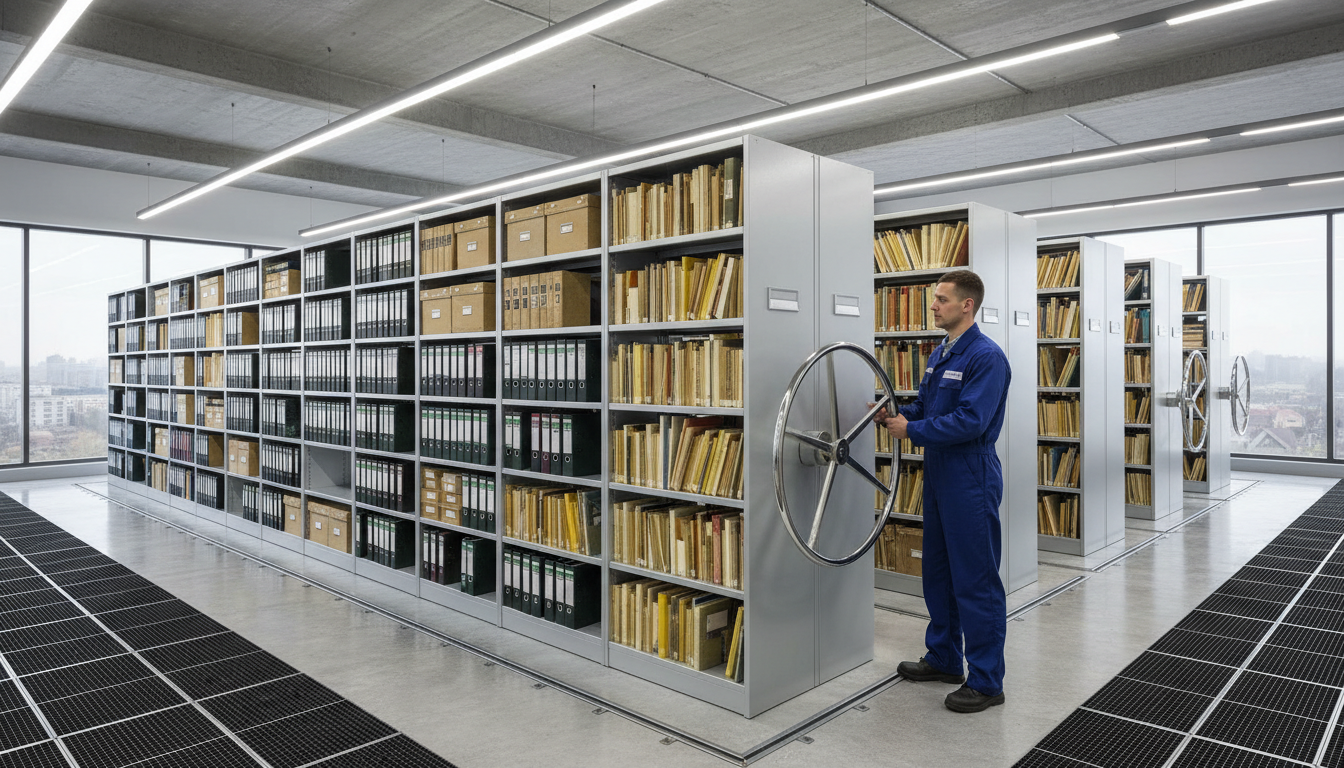
Storage systems are often overlooked in fire safety assessments, yet they represent a significant concentration of combustible fuel in the form of paper records and office supplies. When implementing high-density mobile compactors, facilities managers must balance space efficiency with the egress requirements stipulated in the Fire Code. RA 9514 mandates specific clear width requirements for travel paths; for instance, any corridor serving an occupant load of 50 or more must maintain a minimum clear width of 1.12 meters. Overcrowding a layout with storage units that encroach upon these paths is a common reason for failing a Bureau of Fire Protection (BFP) inspection.
While the steel construction of these units is inherently non-combustible and helps contain localized ignition, the placement of the system is the primary factor in achieving office furniture fire safety Philippines RA 9514 compliance. Storage units must never be positioned in a way that obstructs fire sprinkler heads or smoke detectors. A minimum vertical clearance of 457 mm (18 inches) between the top of the storage unit and the sprinkler deflector is generally required to ensure an unobstructed spray pattern.
When sourcing through government procurement furniture channels, it is vital to coordinate with your office furniture supplier to ensure the floor loading and layout plans align with the building’s fire suppression strategy. Expert office fit-out services will include a detailed spatial analysis, ensuring that mobile compactors do not just save space, but do so without compromising the life safety standards of the facility.
Navigating BFP Inspections for New Office Fit Outs

The Bureau of Fire Protection (BFP) serves as the ultimate arbiter of safety before an office becomes operational. Their inspectors conduct thorough walk-throughs to verify that the physical installation matches the plans approved during the FSEC stage. During these inspections, the BFP focuses on two main areas: physical evidence and technical documentation. Inspectors look for certification labels on seating, check that operable walls do not hinder egress, and ensure that the layout maintains the required corridor widths established in the code.
A critical component of this process is the Fire Safety Compliance and Commissioning Report (FSCCR). This document acts as a formal declaration that all installed fire safety features, including the flame retardant properties of the furniture and interior finishes, meet the standards of RA 9514. Procurement officers must ensure that their office fit-out services provider compiles this report accurately.
Working with a specialized office furniture supplier like RA Integrated Solutions streamlines this final hurdle. We provide a comprehensive technical dossier for all delivered assets, including laboratory test results and material certifications. This documentation ensures that your team is fully prepared for the BFP audit. By verifying office furniture fire safety Philippines RA 9514 compliance through verifiable paperwork, you mitigate the risk of operational delays in government procurement furniture projects.
The Difference Between Fire Rated and Flame Retardant Materials
Procurement officers frequently encounter technical terms that appear interchangeable but carry distinct legal implications under the Fire Code. Distinguishing between fire-rated and flame retardant materials is vital for drafting accurate technical specifications for government procurement furniture. A fire-rated classification typically refers to structural components, such as permanent walls or doors, that are engineered to withstand fire for a specific duration, usually one to two hours, without losing structural integrity or allowing heat to pass through.
In contrast, flame retardant describes the properties of interior furnishings, including office seating and modular partitions. These materials are designed to resist ignition or significantly slow the spread of fire once a flame is introduced. When vetting an office furniture supplier, it is essential to specify that upholstery must meet flame retardancy standards like TB 117, 2013 or BS 476 Part 7, rather than requesting structural fire ratings that do not apply to movable assets.
Term | Primary Application | Regulatory Metric |
|---|---|---|
Fire-Rated | Structural walls, doors, and floor assemblies. | Time-based (e.g., 60 or 120-minute fire resistance rating). |
Flame Retardant | Upholstery, curtains, and partition fabrics. | Surface ignition and flame spread resistance (e.g., Class A). |
Utilizing the correct terminology ensures office furniture fire safety Philippines RA 9514 compliance by aligning procurement documents with the Bureau of Fire Protection’s specific testing requirements for interior assets and office fit-out services. Mislabeling these requirements in bidding documents can lead to non-compliant submittals that fail to meet the rigorous safety standards required for Philippine institutional spaces.